.png)
Your Ego Is Not Going to Like This Workout: Why Regression Is Sometimes the Fastest Path to Strength and Better Movement

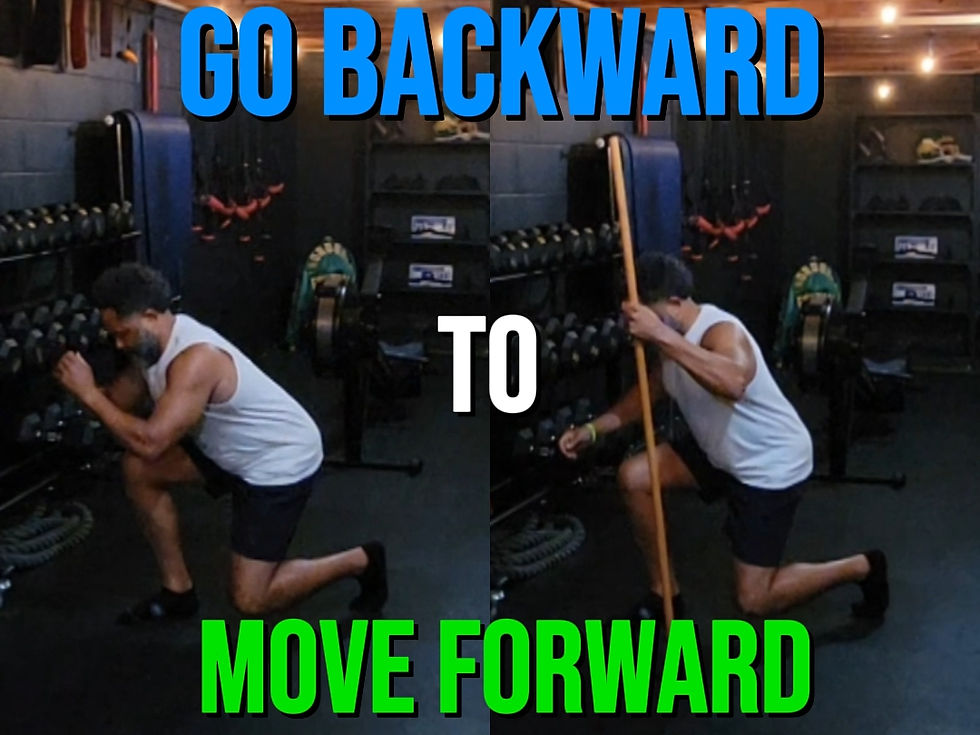
There is a word in the fitness industry that a lot of people absolutely hate.
Regression.
Tell someone they need to regress an exercise and you might as well tell them they need to give back their gym membership.
I get it. Nobody wants to feel like they are going backward. If you've been working on your squat, you want to squat deeper. If you've been doing lunges, you want to add weight. If you've been practicing push-ups, you want to knock out more reps.
But when I tell one of my clients to regress an exercise, I am not telling them they are weak, out of shape, or failing.
I'm telling them we're going to find a better starting point.
Why Do I Use Regressions With My Clients?
Because the exercise you want to perform and the exercise your body is currently prepared to perform may not always be the same thing.
You might have the strength but lack the mobility to get into the position. You might have the mobility but lack the stability to control it. You might have enough strength to complete a repetition but not enough control to perform it safely and consistently.
Sometimes there is an orthopedic issue involved. Sometimes balance is the limiting factor. Sometimes the movement simply hasn't been practiced enough.
And sometimes, quite honestly, the exercise is just too damn hard right now.
That's where a regression comes in.
A regression allows me to change the demands of an exercise so you can practice the movement while addressing the thing that is holding you back.
That distinction is important.
I'm
not making the exercise easier just to make it easier. I'm making it appropriate for YOU.
YOUR EGO IS NOT GOING TO LIKE THIS WORKOUT
Think Foundation, Not Failure
Think about building a house.
You wouldn't look at the foundation and say, "This isn't impressive enough. Let's skip it and start with the second floor."
You build the foundation first because everything above it depends on what is underneath.
Training works the same way.
If you cannot control a movement because of strength, stability, mobility, balance, or range-of-motion limitations, repeatedly forcing the full version may not be the best way to improve.
Instead, I can modify the exercise so we can train the qualities you need.
Maybe you need more stability.
Maybe you need to develop strength in a specific range.
Maybe we need to improve your ability to control the lowering portion of a movement.
Maybe you simply need more practice.
The regression gives us a place to work.
And then we build from there.
Regression Does Not Mean We Stay There
This is another important point.
A regression is not a permanent sentence.
When I use a regression with a client, I'm watching for opportunities to progress it.
Can you perform more repetitions with control?
Can you use less assistance?
Can you move through more range of motion?
Can you handle more resistance?
Can you maintain better balance?
Can you perform the movement without compensating?
Those are the things I'm looking for.
The goal isn't to keep you doing the easiest version of an exercise forever. The goal is to give you the appropriate challenge today so we can create the capacity for a greater challenge tomorrow.
That's progression.
This Is Why I Don't Give Everyone the Same Workout
Two people can walk into the gym and have completely different abilities even if they are the same age, have similar goals, and look relatively similar on the outside.
One person may be able to squat comfortably but struggle with balance during a lunge.
Another may have great balance but lack the mobility to reach the depth we want.
Someone else may have plenty of strength but poor movement control.
So why would I give all three people the exact same exercise and expect the same result?
I wouldn't.
This is one of the reasons I coach movement instead of simply handing people a list of exercises.
I'm looking at how you move, not just whether you can technically complete a repetition.
For example, a squat might become a box squat. A lunge might become a supported lunge.
A hinge might be temporarily replaced with a simpler hip-extension exercise. A push-up might involve more emphasis on the lowering phase. An overhead press might be modified to change the pressing angle.
Those are not random substitutions.
They're decisions based on what I see.
And that's where coaching matters.
Want to See What I Mean?
It's one thing for me to tell you that a regression can help build strength, stability, mobility, or movement control.
It's another thing to actually see it.
Below are a few examples of how I might modify a movement when a client isn't quite ready for the full version. These aren't meant to be one-size-fits-all prescriptions. They're examples of how I can change an exercise to match someone's current abilities while still working toward the bigger goal.
Squat → Box Squat[WATCH THE SQUAT REGRESSION]
Lunge → Hand-Supported Lunge[WATCH THE LUNGE REGRESSION]
Hinge/RDL → Glute Bridge[WATCH THE HINGE REGRESSION]
Push-Up → Floor Eccentric Push-Up[WATCH THE PUSH-UP REGRESSION]
Overhead Press → Landmine Press[WATCH THE PRESSING REGRESSION]
The important thing isn't memorizing these five regressions.
It's understanding why a movement might need to be changed in the first place.
Your regression may look completely different from someone else's. That's because your starting point, limitations, training history, and goals are different.
That's where individualized coaching comes in.
Your Starting Point Doesn't Have to Look Like Everyone Else's
One of the biggest mistakes I see is comparing your exercise to somebody else's.
You see someone squatting "ass to grass" with a barbell and think that's what your squat should look like.
You see someone cranking out 30 perfect push-ups and wonder why you can't do five.
You see somebody performing heavy walking lunges and decide you're somehow behind.
But you're not training their body.
You're training yours.
Your job isn't to perform an exercise exactly like somebody else. Your job is to improve what you can currently do.
That might mean starting with a regression that looks ridiculously easy compared with what somebody else is doing.
That's okay.
Because if that exercise allows you to build strength, control, confidence, and better movement, it isn't easy.
It's appropriate.
And appropriate training is what allows you to progress.
So Don't Be Afraid to Go Backward
If I ever tell you we're going to regress an exercise, don't look at it as a step backward.
Look at it as a step toward something better.
We're not lowering the bar.
We're building the strength, stability, mobility, and control required to raise it.
And eventually, that regression may no longer be necessary.
You'll be stronger.
You'll have more control.
You'll own more range of motion.
You'll have more confidence.
And you'll be ready for the next challenge.
That's why I say:
Regression = Progression.
Sometimes the smartest way to move forward is to take one step back first.
Need Help Figuring Out Where to Start?
Knowing that you need a regression is one thing.
Your ego is not going to like this workout, but knowing which regression to use, why you're using it, and when you're ready to progress is where individualized coaching comes in.
If you're struggling with a movement or you're not sure whether your current exercise program is challenging you appropriately, let's figure it out.
Don't force a movement your body isn't ready to own.


Comments