.png)
Why Body Composition Matters More Than Weight For Women Over 40

By Coach JB

Why the Scale Is Lying to You
If you are a woman in your 40s or 50s and feel frustrated with fat loss, you are not broken, lazy, or failing. You have likely been given outdated advice that no longer matches how your body works today.
For decades, women have been told that the key to staying lean is simple: eat less and move more. When you are younger, that approach can appear to work. Your body is resilient, hormones are more forgiving, muscle mass is easier to maintain, and metabolism responds quickly to almost any stimulus.
But somewhere in your 40s, things change. The scale stops responding the way it used to. Eating less feels harder. Workouts feel more draining. Progress slows or stops entirely.
The common explanation is age or menopause. While hormonal shifts do matter, they are not the real root of the issue.
The real issue is muscle loss.
And here is why body composition matters more than weight.
Weight Tells You How Heavy You Are, Not How Healthy You Are
The scale measures one thing only: total body weight. It does not tell you how much of that weight is muscle, fat, bone, or water.
Two women can weigh exactly the same and look completely different. One may be strong, lean, and energetic. The other may feel soft, tired, and inflamed. The difference is body composition.
Health risks are far more closely tied to fat distribution and muscle mass than the number on the scale. Low muscle mass is associated with insulin resistance, slower metabolism, poor balance, increased injury risk, and loss of independence as we age.
Chasing weight loss without considering muscle often leads to worse health outcomes, not better ones.
What Actually Changes in Your 40s and 50s
Beginning as early as your 30s, adults lose muscle mass at a slow but steady rate if they do not actively train to maintain it. This process accelerates in your 40s and 50s.
Muscle is incredibly metabolically active. It helps regulate blood sugar, supports joint health, protects bone density, and allows you to burn more calories at rest.
When muscle mass declines, metabolism slows. This is not because your body is broken. It is because the engine is shrinking.
When you respond to a slower metabolism by eating less and doing more cardio, you make the problem worse. Severe calorie restriction and excessive endurance exercise increase muscle loss, raise stress hormones, and make fat loss harder over time.
This is why doing more while eating less eventually backfires.
The Problem With Traditional Dieting
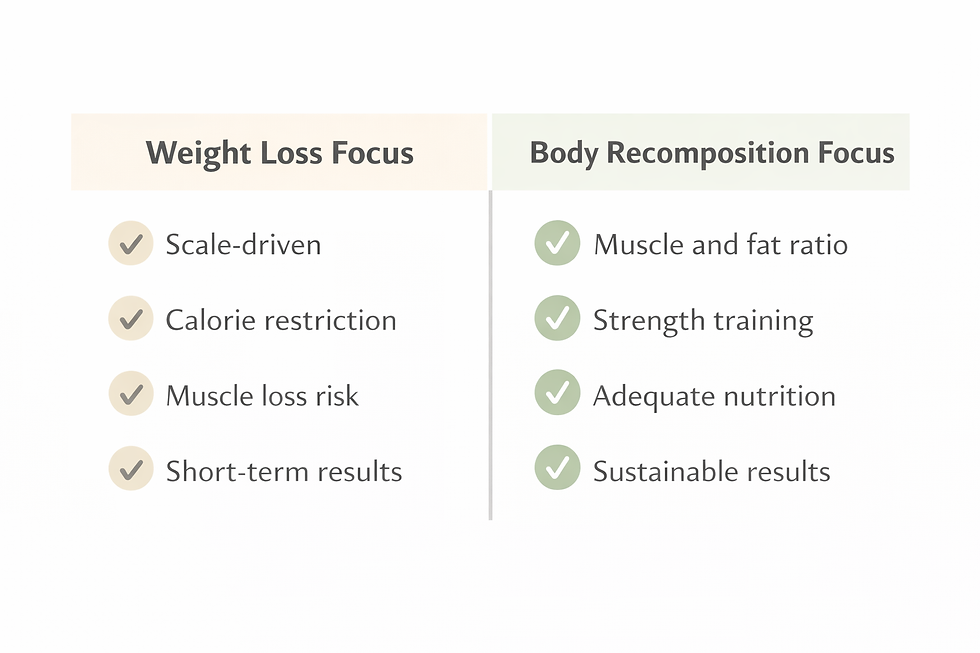
Most diets are designed around weight loss, not health or longevity. They focus on cutting calories aggressively and eliminating entire food groups.
While this may cause short-term weight loss, much of that weight comes from muscle and water, not body fat.
For women over 40, this approach is especially damaging. It increases fatigue, worsens recovery, disrupts hormones, and accelerates muscle loss.
You end up lighter but softer, smaller but weaker, and often more frustrated than when you started.
This is not a discipline issue. It is a strategy issue.

What Body Recomposition Really Means
Body recomposition is the process of losing body fat while maintaining or building lean muscle mass.
Instead of focusing on the scale, the focus shifts to how your body looks, feels, and performs.
With body recomposition, the scale may barely change, yet your waist gets smaller, clothes fit better, strength increases, and energy improves.
This approach is particularly powerful for women in their 40s and 50s who do not have large amounts of weight to lose but want to look leaner and feel stronger.
Why Body Composition Matters More Than Weight and how women can build muscle, boost metabolism, and look leaner without dieting.
Building or preserving muscle improves metabolic rate, insulin sensitivity, and hormonal balance. Muscle also creates the toned appearance most women want when they say they want to lose weight.
Fat loss that occurs alongside muscle preservation leads to a leaner look, not just a smaller version of the same body.
Most importantly, body recomposition is sustainable. You are fueling your body, not fighting it.
The Role of Strength Training
Resistance training is non-negotiable for women over 40 who want fat loss, health, and longevity.
Strength training sends a powerful signal to your body to preserve and build muscle. It improves bone density, joint health, balance, and confidence.
Lifting heavier weights over time is essential. Light weights performed endlessly do not provide the same stimulus.
The goal is progressive overload. This means gradually increasing resistance, repetitions, or complexity as your body adapts.
Consistency matters more than perfection. Two to four well-designed strength sessions per week can transform body composition when done correctly.
Why Eating More Can Lead to Fat Loss
This is the hardest concept for many women to accept.
If you are under-eating, especially protein, your body will resist fat loss. It will conserve energy, increase cravings, and break down muscle tissue.
Eating enough supports recovery, hormone production, and muscle growth.
Protein is especially critical. It preserves lean mass, supports satiety, stabilizes blood sugar, and improves body composition outcomes.
Women over 40 generally benefit from higher protein intake than they consumed in their younger years.
Carbohydrates also matter. Avoiding carbs entirely increases stress hormones, worsens training performance, and impairs recovery.
Fiber-rich carbohydrates support gut health, energy, and hormonal balance.
Sleep, Stress, and Alcohol Matter More Than You Think
You cannot out-train poor sleep or chronic stress.
Inadequate sleep increases hunger hormones, reduces insulin sensitivity, and impairs muscle recovery.
Alcohol interferes with protein synthesis, sleep quality, and fat metabolism. Even moderate intake can slow body recomposition progress.
Reducing alcohol, improving sleep hygiene, and managing stress are not optional extras.
They are part of the strategy.
Why Consistency Beats Intensity
Many women do the right things inconsistently. Random workouts. Sporadic dieting. Short bursts of motivation followed by burnout.
Body recomposition requires consistent inputs over time.
Strength training performed correctly.
Adequate protein and calories.
Quality sleep.
Reduced alcohol.
These do not need to be extreme. They need to be consistent.
What Progress Really Looks Like
Progress is not daily scale changes.
Progress is improved strength.
Better energy.
Clothes fitting differently.
Improved posture.
Reduced aches and pains.
Confidence returning.
When you shift your focus from weight loss to body composition, success becomes measurable in meaningful ways.
If you are a woman in your 40s or 50s and want to change how your body looks and feels, weight loss should not be the goal.
Body composition should.
Build muscle.
Fuel your body.
Train with intention.
Recover like it matters.
Do this consistently and you will not only look leaner, you will age stronger.


Comments