.png)
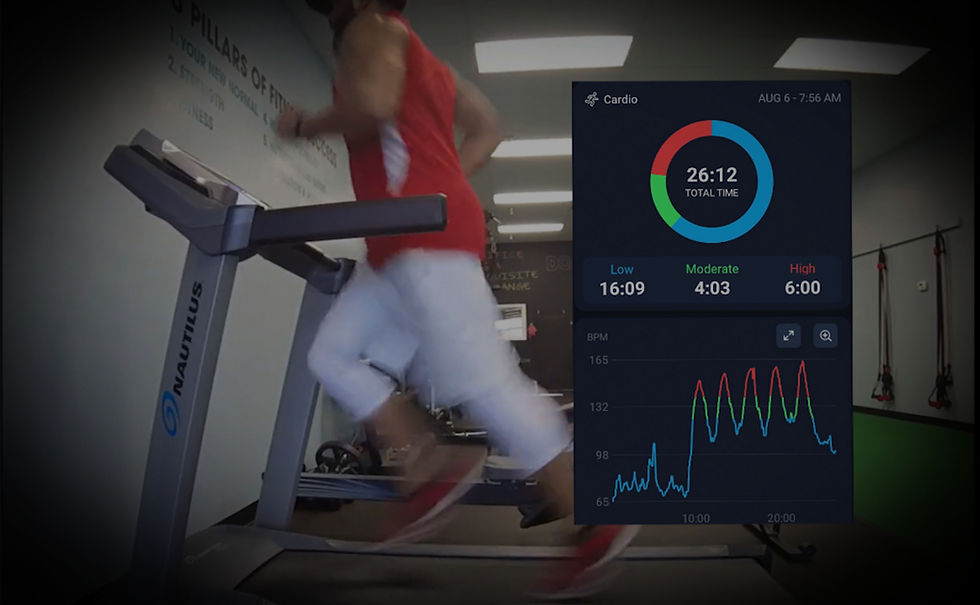
Your Maximum Heart Rate Declines With Age. Does Your Fitness Have To?

Your Maximum Heart Rate Declines With Age
If you've ever looked at your heart rate during a workout and thought, "Well, that number definitely isn't what it used to be," you're not imagining things.
As we progress through he decades of our life, our maximum heart rate generally decreases. It is a normal part of getting older and happens even to people who exercise regularly. Your heart's electrical system changes, the heart becomes somewhat less responsive to adrenaline, and other age-related changes affect how quickly your heart can beat during all-out exercise.
In other words, your heart's top speed has a tendency to slow down with age.
But here's where things get interesting.
A lower maximum heart rate does not automatically mean you're becoming less fit.
Your maximum heart rate is simply the highest number of beats per minute your heart can reach during maximal effort. It is not a complete measurement of your fitness.
Think of it like the redline on your car's tachometer. The redline tells you the engine's upper limit, but it doesn't tell you how efficiently the car performs at 40, 60, or 70 miles per hour.
Your body works much the same way.
Cardiorespiratory fitness is influenced by much more than how fast your heart can beat.
Your fitness also depends on how much blood your heart can pump with each beat, how effectively your blood delivers oxygen throughout your body, and how efficiently your muscles can extract and use that oxygen. These factors all contribute to your VO₂ max, one of the best measures we have of aerobic fitness.
And this is good news for those of us who are no longer in our twenties.
You can continue improving your fitness even while your maximum heart rate gradually declines.
Research has shown that people across a wide range of ages can improve VO₂ max through training. In one study, adults ranging from their twenties into their seventies improved their VO₂ max following high-intensity interval training. Research in older adults has also found meaningful improvements in aerobic capacity following structured endurance training.
So instead of obsessing over whether you can still hit the same heart rate you did 20 years ago, start paying attention to what your body can accomplish below that ceiling.
Can you walk, run, cycle, swim, or play your favorite sport at the same pace with a lower heart rate?
Can you sustain a higher workload at the same heart rate?
Can you recover faster after a hard effort?
Can you handle more training without feeling completely wiped out afterward?
Those are much more useful signs that your aerobic system is becoming more efficient.
Your heart rate zones may also shift as you age because they are based, at least in part, on your maximum heart rate. Age-predicted formulas such as 220 minus your age are useful starting points, but they are estimates, not personalized measurements. The American
Heart Association specifically describes these numbers as general guides because individual maximum heart rates can vary considerably.
So don't panic when the number at the top of your heart-rate monitor starts looking a little less impressive.
Your heart may have a lower ceiling, but that doesn't mean your fitness has to live on the ground floor.
The goal as we get older isn't to chase a younger heart rate. It's to build a body that can do more with every heartbeat.
That's what training smarter is really about.
Stop measuring your fitness by the highest number your heart can reach.
Instead, pay attention to how much work you can do, how efficiently you can do it, and how quickly you recover.
Your maximum heart rate declines with age.
Your fitness doesn't have to.
Ready to stop chasing numbers and start training smarter?
Take a closer look at how you're training, recovering, and progressing. Your best fitness isn't necessarily behind you. It may simply require a smarter approach to getting there.
Train smarter. Move better. Live stronger.


Comments