.png)
Smart Cardio: Train Your Heart, Protect Your Healthspan, Burn Fat the Right Way
- Jon Brown

- Mar 4
- 4 min read
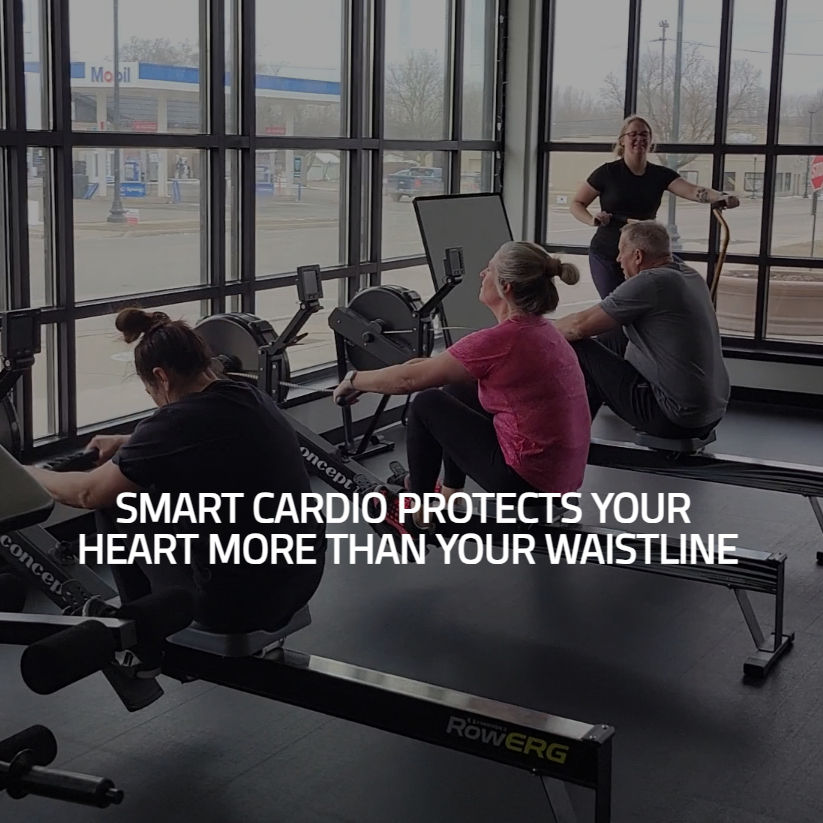
SMART CARDIO
For years, we were told that more cardio was the answer. More sweat. More miles. More time on the treadmill.
If sweating more guaranteed fat loss, we would all be lean after mowing the lawn in July. But cardio is powerful for midlifers, and it just isn’t mainly about losing weight.
Cardio is first and foremost a cardiovascular health tool. Fat loss is a secondary benefit. Once you understand that, your entire approach changes.
What Smart Cardio Really Means
Smart Cardio is not about doing more. It is about doing the right type at the right intensity for the right reason.
For midlifers, this matters even more. Your body at 50 is not your body at 25. Recovery takes longer. Stress is higher. Hormones shift. Joints have mileage. Smart Cardio respects that reality instead of ignoring it.
Instead of punishing yourself with long, exhausting sessions that leave you drained, you build your aerobic engine strategically and layer in high intensity work with purpose.
Low Intensity Cardio Is the Foundation
Low intensity cardio (formally called Zone 2 training for obvious reasons), or often called LISS (Low Intensity Steady State), is what I now call, Cardiac Output is the base of the pyramid.
This is the pace where you can carry on a conversation but still feel like you are working. It may not feel impressive, but physiologically it is extremely powerful.
At this intensity, you strengthen the heart muscle and improve stroke volume, meaning your heart pumps more blood with each beat. You increase mitochondrial density, which improves your body’s ability to produce energy efficiently. You enhance fat oxidation, improve insulin sensitivity, and lower resting heart rate and blood pressure.
For disease prevention, this is huge. Cardiovascular disease remains one of the leading health risks as we age. Building an aerobic base reduces strain on the heart and improves circulation. It literally makes your engine stronger.
There is also an immune benefit. Moderate aerobic training supports immune surveillance and helps regulate inflammation. In simple terms, your body becomes more resilient.
And here is the interesting part. Low intensity cardio trains your body to become better at using fat for fuel over time. Not because you are chasing calorie burn during the workout, but because you are improving your metabolic machinery. That is long term thinking.
Sample Program for Cardiovascular Health
3 to 4 days per week
30-60 minutes per session
Brisk walking, cycling, incline treadmill, rowing, or sled drags
Keep the pace conversational
Pair this with two to three days of strength training to preserve muscle and joint integrity. It does not need to be extreme. It needs to be consistent.
Where High Intensity Fits In
High intensity training or Threshold Training absolutely has value. But it is not the foundation. It is the spice.
Short bursts of harder effort improve VO2 max, which is one of the strongest predictors of longevity and all cause mortality. A higher VO2 max is associated with a lower risk of dying from cardiovascular disease and other causes.
High intensity intervals train your heart to pump more efficiently under stress and improve oxygen delivery to working muscles. They also burn more calories in a shorter time frame, which can support fat loss when nutrition is aligned.
But here is the catch. Too much high intensity work elevates stress hormones, impairs recovery, and can leave midlifers exhausted instead of energized. Smart Cardio uses intensity strategically, not emotionally.
Sample High Intensity Session
1 to 3 days per week after a proper warm up
Option 1
6 rounds of 30 seconds hard effort followed by 90 seconds easy recovery
Option 2
4 rounds of 2 minutes hard effort followed by 2 minutes easy recovery
You should finish feeling challenged but capable. Not crushed.
Using Smart Cardio for Weight and Fat Loss
This is where many people get confused. Fat loss is primarily driven by nutrition and overall energy balance. Cardio supports the process. It does not lead it.
Smart Cardio helps by improving insulin sensitivity, increasing daily energy expenditure, enhancing recovery between strength sessions, and preserving metabolic flexibility.
But without adequate protein intake and resistance training, cardio alone rarely produces lasting fat loss.
The smartest approach for midlifers looks like this:
Strength training 2 to 3 days per week (Full Body)
Cardiac Output cardio 2 to 3 days per week
One short Threshold Training session per week
A protein focused nutrition strategy
Sample Weekly Smart Cardio Plan for Fat Loss
Monday
Full body strength + a short 5 to 10 minute Threshold Training session
Tuesday
Cardiac Output for 40 minutes
Wednesday
Full body strength + 5 to 10
Thursday
Cardiac Output for 30 minutes
Friday
Full body strength
Saturday
Short Threshold Training interval session 15 to 20 minutes
Sunday
REST
This structure protects muscle, supports hormones, improves heart health, and creates sustainable fat loss without burnout.
Cardio Is About Your Engine
If you are over 50, your goal is not to burn the most calories in a single session.
Your goal is to build the strongest, most resilient engine possible.
A strong heart
Efficient lungs
Healthy blood vessels
Stable blood sugar
Preserved muscle
That is healthspan.
Smart Cardio is not flashy. It will not leave you crawling off the gym floor. But it builds capacity, resilience, and long term vitality.
And when you build the engine correctly, body composition improves as a byproduct.
If you want a personalized Smart Cardio plan built around your recovery, strength training, and fat loss goals, apply for a free Conditioning Strategy Session.
Stop chasing sweat. Start building your engine. Train with purpose. Protect your healthspan.
Let the fat loss follow.


Comments