
Metabolism and Aging: What Does Science Actually Say?

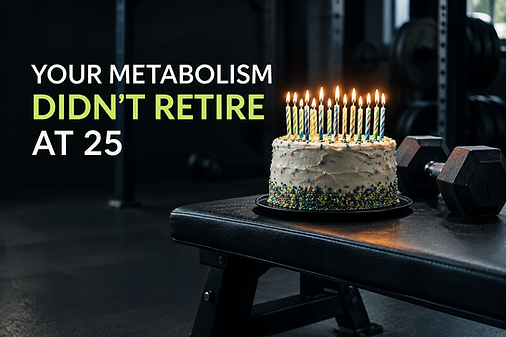
Apparently, your metabolism is scheduled to die at 25.
Then 30.
Then 40.
Then 50.
At this rate, your metabolism needs its own retirement party, complete with cake and a gold watch.
When I was a teenager, people told me to wait until I was 25 because my metabolism would slow down. When I reached 25, the deadline moved to 30. Then 40. Now I'm wondering who keeps moving the finish line!
Don't get me wrong. Aging is real, and our bodies change over time. But the idea that your metabolism suddenly falls off a cliff because you celebrated another birthday? The research doesn't support that story.
Metabolism and Aging: What Does Science Actually Say?
In 2021, researchers published a major study in the journal Science examining daily energy expenditure in more than 6,400 people ranging from 8 days old to 95 years old. Using a sophisticated method to measure energy expenditure, the researchers found that, after accounting for fat-free mass, energy expenditure remained relatively stable from approximately ages 20 to 60. It then declined during older adulthood.
In other words, turning 25, 30, 40, or 50 does not automatically send your metabolism into early retirement.
Now, this doesn't mean everyone's metabolism is identical or that aging has no effect. Your health, body composition, activity levels, and other individual factors matter. But there is no magical birthday when your body's calorie-burning machinery suddenly breaks down.
So why do so many people feel like their metabolism has slowed to the speed of a shopping cart with one bad wheel?
Let's look at what may actually be happening.
Muscle Matters, But It Isn't a Magic Calorie-Burning Machine
One important piece of the puzzle is your body composition, particularly how much fat-free mass you have. This includes your muscles, organs, bones, and other tissues.
Your body requires energy even when you're sitting on the couch watching television. That's called resting energy expenditure, and your organs and other tissues use energy to keep you alive. Fat-free mass is a major factor influencing how much energy your body uses at rest.
Here's where resistance training comes into the picture.
If you gradually lose muscle over the years, your body composition changes. Your resting energy needs may change, too. However, muscle isn't some magical furnace that burns thousands of extra calories while you sleep. Building and maintaining muscle is valuable for many reasons, and its contribution to resting calorie expenditure is only one piece of the puzzle.
Muscle also helps you lift groceries, climb stairs, get up from the floor, carry your luggage, and keep doing the activities you enjoy without needing someone to help you.
I'd say that's a pretty good return on your training investment.
The Other Part of the Equation? How Much You Move
Your total daily energy expenditure includes the energy your body uses at rest, the energy required to digest food, and the energy you use through physical activity.
Think about your own life for a moment. When you were younger, perhaps you played sports, walked more, took the stairs, or spent more time doing things that kept you moving. As work, family responsibilities, and other demands took over, some of that activity may have disappeared.
You might now spend more time sitting, take fewer steps, and move less throughout the day. You may also have lost some muscle along the way.
Then the scale creeps up, your clothes fit differently, and suddenly your metabolism gets accused of a crime it may not have committed.
Your birthday isn't necessarily the whole story. Changes in your daily habits, body composition, food intake, sleep, health, and activity can all contribute.
The good news? Many of these factors are things you can work on.
You're Never Too Old to Build Muscle
Here's the part I really want you to remember: you can improve your strength and build muscle even if you haven't spent years lifting weights.
In a classic 1990 study published in JAMA, researchers studied frail adults living in a nursing home whose average age was approximately 90. After eight weeks of high-intensity resistance training, the nine participants who completed the program increased their strength by an average of 174%. Their mid-thigh muscle area increased by approximately 9%, and walking performance improved.
Let that sink in for a moment.
These weren't twenty-something athletes chasing personal records. They were very old, frail adults who demonstrated that meaningful physical improvements were still possible.
That doesn't mean everyone will achieve those results, and people with different health conditions or abilities need appropriate training plans. But it does challenge the idea that your opportunity to get stronger expires with age.
You don't need to become a bodybuilder. You need a sensible plan that matches your current ability, challenges you appropriately, and progresses as you improve.
What Should You Do With This Information?
Start by focusing on the things that support your health and physical independence.
Include resistance training in your routine to build or preserve muscle. Stay active outside the gym instead of assuming one workout can compensate for an otherwise sedentary day.
Eat enough protein and follow a balanced nutrition plan that supports your goals. And make adjustments as your schedule, abilities, and health needs change.
If you're 45, 55, 65, or 75 and haven't started strength training, you haven't missed your opportunity. You may need a different starting point than someone younger, but you can still work toward meaningful improvements.
This is where evidence-based coaching can help. The right guidance can take the guesswork out of training, help you develop sustainable nutrition habits, and give you a plan that fits your life rather than requiring your life to revolve around your plan.
Growing older is inevitable. Losing your strength, giving up on movement, and assuming nothing can improve simply because of your age are not inevitable outcomes.
Your metabolism doesn't have a birthday deadline. And neither does your ability to get stronger.
The question isn't whether you're too old to start. It's what are you waiting for?
References and supporting research:
1. Pontzer H, et al. (2021). Daily energy expenditure through the human life course. Science, 373(6556), 808–812. This large study analyzed energy expenditure across the lifespan and found that fat-free-mass-adjusted expenditure remained stable from approximately ages 20 to 60 before declining in older adulthood.
Read the study: PubMed: Daily Energy Expenditure Through the Human Life Course
2. Fiatarone MA, et al. (1990). High-intensity strength training in nonagenarians: Effects on skeletal muscle. JAMA, 263(22), 3029–3034. This intervention study found improvements in strength, muscle size, and functional mobility in very old nursing-home residents following resistance training.
Read the study: PubMed: High-Intensity Strength Training in Nonagenarians
3. Zampino M, et al. (2020). Longitudinal changes in resting metabolic rates with aging are accelerated by diseases. Nutrients, 12(10), 3061. This longitudinal analysis explored how aging, health status, and chronic disease relate to changes in resting metabolic rate. It supports the important distinction that metabolic changes vary between people and are not explained by birthdays alone.


Comments